
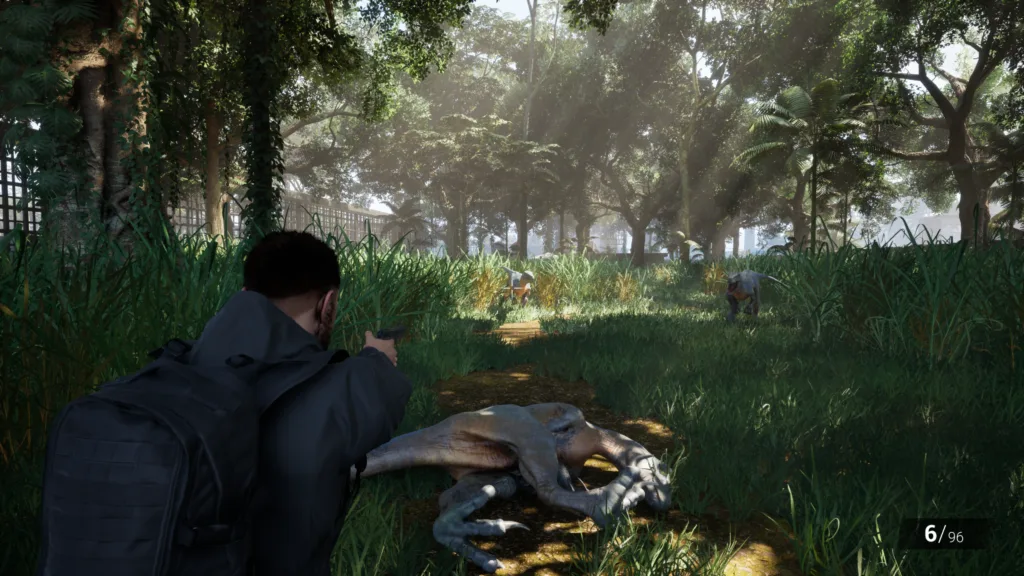
What Classic Mode changes
The official store presents Classic Mode as the original Clawed survival-horror experience. It keeps the park exploration, combat, puzzles, and mission route without the additional survival-resource systems listed for Survival Mode.
What Survival Mode adds
Survival Mode adds hunger, thirst, dynamic weather, a full day/night cycle, and random dinosaur encounters. These systems increase planning pressure, but the official description does not publish fixed depletion rates or a universal difficulty multiplier.
Which mode should you choose?
Start with Classic if you mainly want the authored horror and puzzle route. Pick Survival if tracking resources and adapting to changing conditions is part of the appeal. This is a preference choice, not a claim that one mode is the correct way to play.
How mode choice affects a co-op group
Developer information confirms that all modes can be played with up to four players. Before inviting friends, agree on the mode so the group expects the same level of resource pressure. Classic lets a new team concentrate on learning interaction prompts, combat, and the objective chain. Survival adds reasons to share supplies, watch the time of day, and adapt to changing conditions. The sources do not publish formal player roles, fixed resource-drain rates, or a universal recommendation for four-player balance, so those details are not invented here. Treat coordination tips as practical advice, not hidden game rules.
Choose by the systems you want to manage
Pick Classic when the authored horror route, puzzles, and combat are the main attraction. Pick Survival when resource tracking and environmental uncertainty are part of the desired challenge. Do not choose based on an unsupported numeric difficulty claim: the official material lists additional systems but does not say Survival is a fixed percentage harder. If you are comparing videos, check which mode the creator selected before copying inventory or pacing advice. A route that looks relaxed in Classic can require more preparation in Survival without the physical objective itself changing.
Match every guide and video to its selected mode
When a walkthrough mentions frequent supply stops, darkness, weather, or unexpected dinosaur placement, confirm that the creator is using Survival before assuming the same pressure applies to Classic. When a Classic route reaches an objective quickly, do not promise identical timing in Survival because resource checks and random encounters can interrupt travel. The physical puzzle evidence may still transfer, but preparation and pacing may not. This site labels mode-specific claims and avoids presenting one recorded session as a universal balance test. If a future patch changes the named Survival systems, the official Steam description should be updated first, followed by focused route advice that depends on those systems.
Frequently asked questions
What is the difference between Classic and Survival Mode?
Survival Mode adds hunger, thirst, dynamic weather, a day/night cycle, and random dinosaur encounters to the core experience.
Should beginners use Classic Mode?
Classic is the simpler starting point if you want to learn the route without the additional survival-resource systems.
Does Survival Mode have exact published difficulty numbers?
The official description lists added systems but does not provide a universal numeric difficulty multiplier.